Spain Opts for Regularization: An Analysis by Camila Ríos Armas
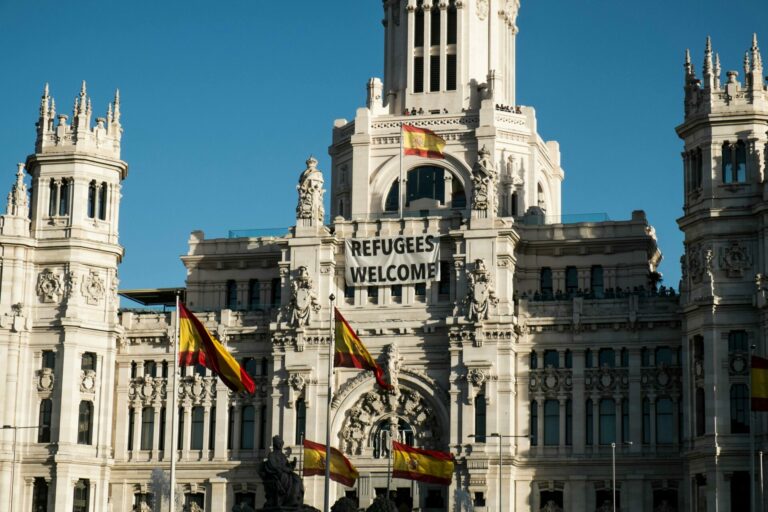
In this article, Camila Ríos Armas reflects on Spain’s historic decision to regularize the status of 500,000 undocumented immigrants, going against the trend of increasingly strict immigration policies in Europe.
« On April 14 of this year, the Spanish government officially approved the decree launching the extraordinary immigration regularization process. This measure targets 500,000 undocumented individuals who arrived in Spain before January 1, 2026, as well as certain individuals who applied for international protection before that date. This decision contrasts with the current reality faced by undocumented migrants in France: the repeal in 2025 of the 2012 ministerial circular (“Valls circular”), which allowed for the regularization of approximately 30,000 people each year on the basis of family ties or employment; a new circular that prioritizes regularization for workers in high-demand occupations and requires seven years of residence in France for all others; a digital system for applying for residence permits (the ANEF platform) with serious structural bugs that prevent users from exercising their rights; and stricter conditions for accessing State Medical Aid, among other measures.
The debate surrounding migration is rife with technical terms and jargon, devoid of any human element: OQTF, regularization, irregular administrative status, CMA, ANEF, AME, etc.
In response to the Spanish government’s decision, the discussion will quickly devolve into a debate over semantics and intentions, drawing parallels with France. People will discuss who is eligible for this new measure and under what circumstances. We’ll hear arguments like: “This measure could never work here.” There will be those who say it is purely economic: “It’s a very pragmatic decision; this isn’t the first time Spain has done this.” Others will say, “It’s a moral and ethical duty; it’s a humanitarian measure.” As if public policy could be reduced to such simplistic explanations.
Some presidential candidates in France will argue that this measure poses a risk to Europe and the Schengen Area, linking Spain’s regularization policy to the risk of secondary movement toward France. As if a regularized person were a naturalized citizen. As if we, non-EU immigrants, could freely settle in an EU country other than the one that issued our residence permit.
Others will focus on the system’s shortcomings, the long lines at the prefectures, and the people who spend the night outdoors to complete their paperwork. Few will speak of those for whom this measure will change their lives. Those who will become visible, whose administrative status will emerge from the shadows, and who will finally have official documents.
Few will also mention the driving force behind the collectives and NGOs that have been fighting for such a reform for six years.
Spain has decided to regularize the administrative status of 500,000 people at a time when migrants are being criminalized. A time when migration is associated with security and
deportation policies. Certain vocal groups will insist that migration, a phenomenon that has always been part of our history, become the scapegoat for all the ills of Western societies.
We see governments investing in surveillance technologies along Europe’s borders and in its waters, and implementing increasingly complex procedures to deport people, even to third countries they have never set foot in.
Others will remain steadfast in their belief that welcoming migration strengthens our societies, and that a society that treats those who come from afar with dignity will be fairer and more equitable overall.
“Esta ley nos salva la vida” (“This law saves our lives”), I read in an article in a Spanish newspaper. Several people describe what they plan to do once they obtain their residence permit: learn English, visit family in their home country, work in decent conditions, pay taxes, open a bank account, go back to school, and so on. The answers vary, but they all have one thing in common: the freedom to dream and plan for the future without the fear that their lives might come to a sudden halt. Because for us, having papers means the certainty that our lives can simply “go on.”
If 500,000 people will be able to emerge from the invisibility to which they have been subjected, and from all the abuses that entails, it is also thanks to the civil society movement. This reform is the result of six years of struggle by the Regularización YA Movement, composed of anti-racist and social justice collectives and associations. Founded in 2020, the movement launched a “Iniciativa Legislativa Popular” (ILP) in 2022 that collected 700,000 signatures. For six years, it has fueled public debate by amplifying the voices of migrants, whether through appeals to elected officials or through awareness-raising and advocacy campaigns
In a world where powerlessness seeks to erode our will, we must believe in the power of swarms, in our ability to expand and contract together as a single living entity, creating movements that break down barriers and forge connections.
By granting legal status to 500,000 people, Spain is opening up a future for these men and women and offering us a window to continue believing in the strength of the collective, in the strength of organizing and mobilizing while always keeping the individual at the center of our actions. »

About Camila Ríos Armas
Camila Ríos Armas was born in Caracas, Venezuela. After a career in political communications in her home country and a master’s degree in international development from Sciences Po Paris, she undertook several volunteer assignments in refugee camps. These experiences, marked by the injustices she witnessed, inspired her to take action. In 2018, she founded the nonprofit organization UniR Universités & Réfugié.e.s to combat the professional marginalization of refugees and promote access to higher education for all.
Now president of SINGA Global, Camila works toward a more inclusive society by placing education and the recognition of refugees’ and asylum seekers’ backgrounds and knowledge at the heart of her commitment.
Notes
- Note 1 : In Spain, an ILP is “a mechanism of direct democracy through which citizens can propose laws to be considered, debated, and approved by Congress. Its approval is binding, meaning it is mandatory.” (Regularizacion YA).
- Note 2: The Spanish regularization measure grants a one-year residence permit allowing the holder to work throughout Spain and in any sector of activity.